Identity, it’s something that we all talk about, read books about, listen to podcasts about, and generally just obsess over. From the time we had conscious thought, we worried about our identity. We chose to be princesses, teachers, or cats (looking at you my fellow Warriors fans) in our playtime. We crafted personalities, stories, and identities for our barbies. Then came middle school, the time of the great identity crisis–who would we be? Identity is something that still sticks with us today, in trying to find that perfect routine, habit, or smoothie recipe that will just make us feel secure in who we are.
The reality is that we are all searching for identity and as believers, we know that our only true identity is in Christ. Even that though can feel confusing. We wonder how we fit into Christ and can still be us. What does it mean to be a Christian? What does it mean to be a daughter of the king? Is it all the same thing? Are there different parts? I propose that our identity in Christ has three major sections, us as servants, slaves, and sons (well daughters, but who doesn’t love good alliteration). All three of these identities are part of being a believer and the combination of these roles gives a full picture of who we are as Christians. Being a slave, servant, and son help me to live out my life secure in who I am in Christ Jesus.
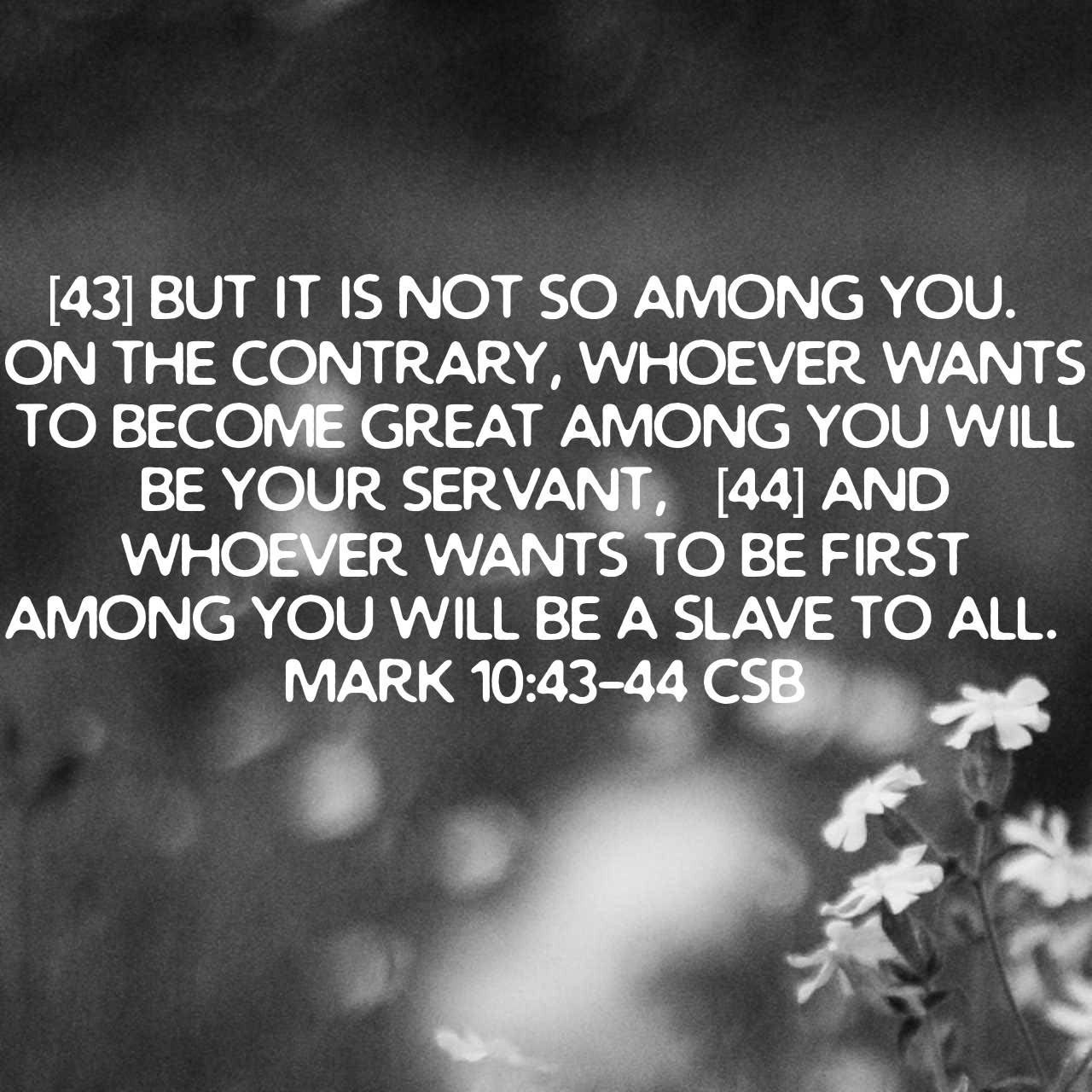
“42 So Jesus called them together and said, “You know that the rulers in this world lord it over their people, and officials flaunt their authority over those under them. 43 But among you, it will be different. Whoever wants to be a leader among you must be your servant, 44 and whoever wants to be first among you must be the slave of everyone else. 45 For even the Son of Man came not to be served but to serve others and to give his life as a ransom for many.” Mark 10:42-45
Jesus’s words to the disciples in Mark 10 come right after James and John ask Jesus to sit on his right and left on thrones in heaven. Even the disciples of Jesus didn’t really understand His kingdom. The Jews believed that the Messiah would come and be a victorious military and political leader. They lived and believed in the physical and imagined a physical kingdom. Jesus, by contrast, was talking about a spiritual kingdom. So in response to their request, after gently rebuking the brothers, Jesus sets out to define the identities of his followers in His kingdom. The first identity that Jesus outlines is a servant. He says in verse 43, “Whoever wants to be a leader among you must be your servant.” The Greek word here for servant is diákonos, which is where the modern term deacon comes from, and it means one who executes the commands of another.
In the next verse, Jesus says, “and whoever wants to be first among you must be the slave of everyone else.” Slave is a different Greek word, doulos. It is not just a servant but a bondsman, one is owned for life. While servant and slave might seem to be very similar terms, the different identities that Jesus is defining are important. Our third identity comes from elsewhere in scripture. John 1:12 says, “But to all who did receive him, who believed in his name, he gave the right to become children of God.” In each of our identities in Christ, we learn different things about ourselves and about our God.
As servants, we are called to execute the commands of God. We are to serve and love others as the hands and feet of God. This is an essential part of our identity as Christians. As Jesus clarifies in John chapter 12, “If anyone serves me, he must follow me; and where I am, there will my servant be also. If anyone serves me, the Father will honor him.” Our role as a servant is to serve God and make His kingdom known. We are to follow Jesus. When this works in tandem with our two other identities, we are used in the kingdom to reach others and showcase His love. If we exist solely as a servant, then we risk falling into the trap of works-based faith. There is a difference between executing God’s commands and being his hands and feet and finding our identity in our service. We have to find our identity not in the service we do, but in who we serve.
As slaves, we are fully sold out to God and His righteousness. As Paul says in Romans 6:22, “But now that you have been set free from sin and have become slaves of God, the fruit you get leads to sanctification and its end, eternal life.” It’s a really hard thing to actually grasp what it means to be a slave of God, fully surrendered. We can often live in fear and paralysis that all decisions we make are not God’s but our own. We can walk in fear that we’re not being “slaves” enough. But the reality of our identity as a slave is that it’s not up to us. The fruit of our slavery is sanctification, worked in us by God through the Holy Spirit. Again, our identity in Christ as a slave can not be rooted in us, but instead His work in us. Being a slave to righteousness is living and trusting in His righteousness that has been graciously given to us. Not by surrendering enough that we earn it.
As sons (or daughters), we claim our identity as equals with Christ. That feels like a big statement. But Paul breaks that down for us in Romans 8.
14 For all who are led by the Spirit of God are sons of God. 15 For you did not receive the spirit of slavery to fall back into fear, but you have received the Spirit of adoption as sons, by whom we cry, “Abba! Father!” 16 The Spirit himself bears witness with our spirit that we are children of God, 17 and if children, then heirs—heirs of God and fellow heirs with Christ, provided we suffer with him in order that we may also be glorified with him.
We are adopted by God. We are His chosen children, and we get the same rights and privileges that Jesus has as God’s only son. Jesus gave up his prized position so that we would walk in our identity as children of God. How incredible is that? As believers, we often don’t accept or believe this part of our identity. That means that we cannot fully appreciate the impact of our other identities. I am a servant of God, but my service doesn’t earn my inheritance because I already have it. I am a slave of God, but I have full assurance of my salvation even if I stumble and act as a slave to sin because I have already been adopted. There is richness and beauty in our sonship (or daughtership). Some others may fully believe in their position as co-heirs with Christ and may claim that without really considering their identity as a servant and a slave. This creates the trap of license where God will not un-adopt me, so I can do whatever I want and grace will cover it all. Grace certainly does cover all of our sins, but that is why all three identities are important and must be considered in tandem. Even though I am a child of God, he also owns all of me and I am made to serve Him and His kingdom. Like a child who loves their Father and works to do all that he asks, so we are called to walk as His children.
All parts of our identity in Christ are necessary to walk as Christians. It won’t be easy and it’s certainly not simple, but we cannot exist in one dimension of who Christ has called us to be. We are servants in light of our slavery and our sonship. We are slaves because of our sonship, and our response is to serve. We are sons who serve and are slaves to our Father’s will. Living in the balance of these identities provides the freedom to walk in our Father’s love. We can be confident in our salvation, trust him with our life, and make Him known to everyone we meet. Remember your identities today, claim them, and walk in Christ Jesus.




Leave a Reply